- Total distance
- 60 km / 37 miles
- Standard duration
- 5 days, 4 nights
- Highest point
- 4,630 m / 15,190 ft
- Daily walking
- 6–7 hours (3 on day 5)
- Ecosystems
- 5
How long is the Salkantay Trek?
The trek covers roughly 60 kilometres (37 miles). The traditional route runs 5 days and 4 nights, with 4-day variations available. Depending on fitness, expect around six to seven hours of walking on the first three days and about three hours on the last stretch from Santa Teresa to Machu Picchu Pueblo.
Why five days? Because day one includes the road transfer out of Cusco and day five includes the climb from Aguas Calientes up to the citadel entrance. The route crosses the Vilcabamba range at the 4,630-metre Salkantay Pass — well above Machu Picchu itself at 2,430 metres. This is not Everest, but hill climbing through rough weather and terrain is guaranteed, even in the dry season.
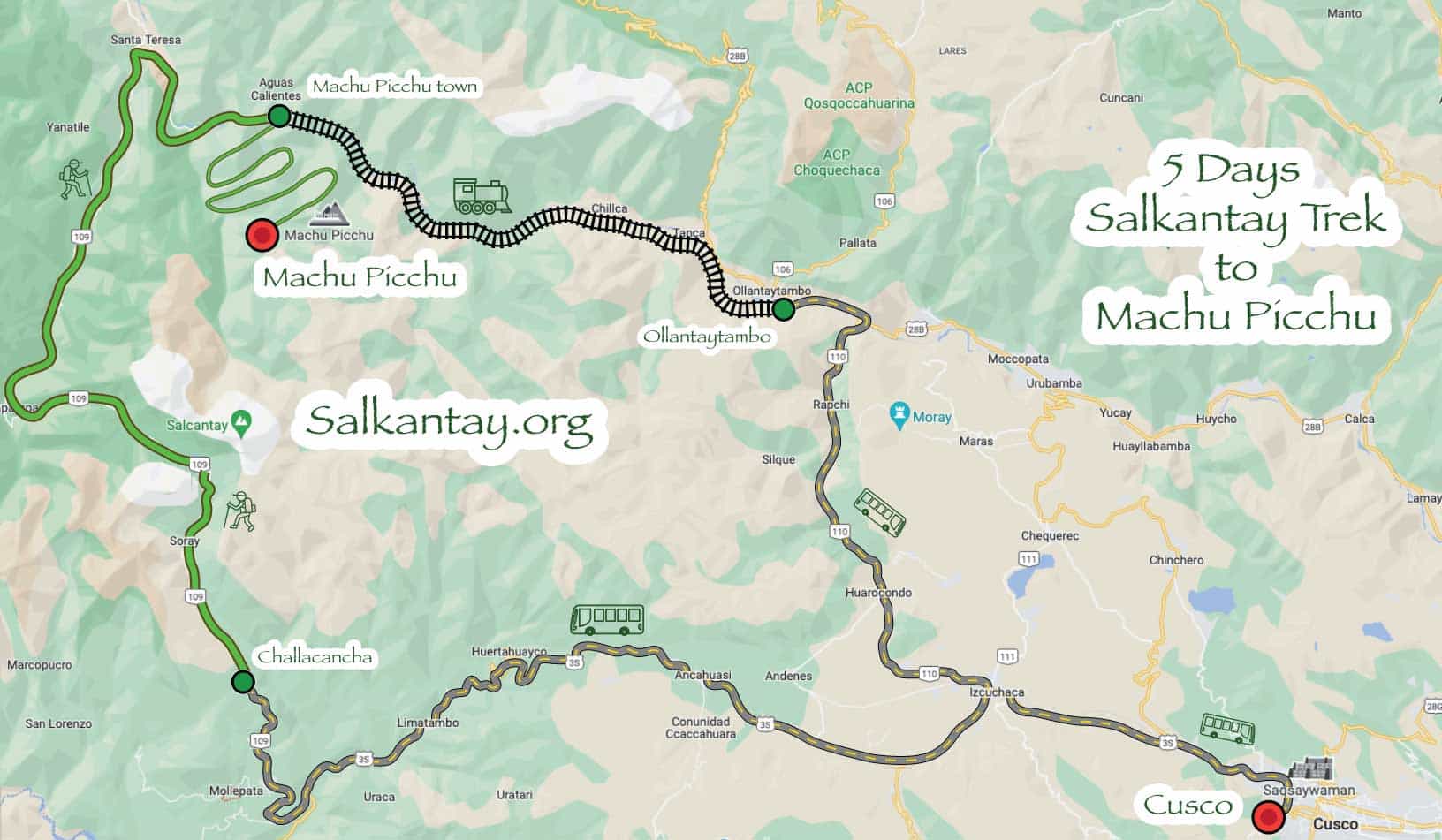
The route map
Day by day through five ecosystems
Here is what each day actually asks of you. The ecological zones referenced below are covered in full in the five ecosystems guide.
Day 1 — Cusco to Soraypampa
- Distance
- 12 km (7.5 mi)
- Hiking time
- 5–6 hours
- Elevation
- +900 m
- Ecosystems
- High Andean valleys → alpine tundra
Highlight: Humantay Lake excursion
An early departure from Cusco (3,400 m) and a three-hour drive to the Mollepata trailhead and Challacancha (3,700 m), where the trek officially starts. The first day is a steady ascent through high Andean valleys to Soraypampa (3,900 m), the first camp.
The day includes the climb to the turquoise Humantay Lagoon — your first ecosystem transition, from agricultural land into alpine tundra.
Day 2 — The Salkantay Pass
- Distance
- 18 km (11 mi)
- Hiking time
- 7–8 hours
- Elevation
- +550 m, then −1,600 m
- Ecosystems
- Alpine tundra → puna → queñua forest edge
Highlight: The high point of the trek
The greatest challenge of the route. From Soraypampa the trail climbs steadily for three to four hours to the Salkantay Pass, with panoramic views of the surrounding glaciers.
After a brief celebration at the top, the descent begins in earnest — alpine tundra giving way to high Andean grassland. By late afternoon you reach Chaullay or Collpapampa (2,900 m) for the second night, noticeably warmer, with the first queñua forest appearing.
Day 3 — Into the cloud forest
- Distance
- 16 km (10 mi)
- Hiking time
- 6–7 hours
- Elevation
- −700 m
- Ecosystems
- Queñua forest → high jungle
Highlight: The world’s highest forest
The most dramatic ecological transition of the trek. Starting in the upper queñua forest, the trail follows the Santa Teresa river valley down, the vegetation thickening with every kilometre.
By midday you are in the ceja de selva — the eyebrow of the jungle — among orchids, bromeliads and a great deal of birdsong. The day ends at Playa Sahuayaco or the Lucmabamba coffee farms (2,100 m), then Santa Teresa for the night.
Day 4 — Ancient rainforest paths
- Distance
- 18 km (11 mi)
- Hiking time
- 6–7 hours
- Elevation
- +300 m, then −700 m
- Ecosystems
- High jungle → cloud forest
Highlight: Llactapata and the first sight of Machu Picchu
The fourth day follows portions of a genuine Inca trail — not the famous one, but an ancient path that linked Machu Picchu to the jungle. It winds through coffee plantations and dense cloud forest, with glacier viewpoints set against tropical foliage.
The route stops at the Llactapata Inca ruins, with their distant view of Machu Picchu across the valley, before descending to the Urubamba and on to Aguas Calientes (1,900 m). Some itineraries route via the Santa Teresa hot springs instead — ask which applies to your departure.
Day 5 — Machu Picchu
- Distance
- 6 km (4 mi) or bus
- Hiking time
- 3 hours
- Elevation
- +530 m
- Ecosystems
- Cloud forest → citadel
Highlight: The Lost City
The final stretch: either the two-hour climb from Aguas Calientes to the citadel gate or the bus up the switchbacks. From the Watchman’s Hut you get the classic view before a guided tour of the Main Square, the Royal Quarters, the Temple of Three Windows and the Intihuatana stone.
Afternoon train to Ollantaytambo and road transport back to Cusco.
Choosing a length
Five days is the standard. The 4-day express compresses the middle by driving one section; the 7-day and 8-day routes add Cusco acclimatization and a slower descent. Compare them all on the treks page.